REORIENT
AN ONLINE LECTURE SERIES AND WORKSHOP
JUNE 6, 13, AND 20 AT 11AM EDT
EDIT: CANCELLED
Due to unforeseen circumstances, we have had to cancel the ReOrient lecture series. We apologize for any inconvenience caused. Please sign up to our newsletter if you wish to be notified if/when this series is rescheduled and to receive updates on our future programming.
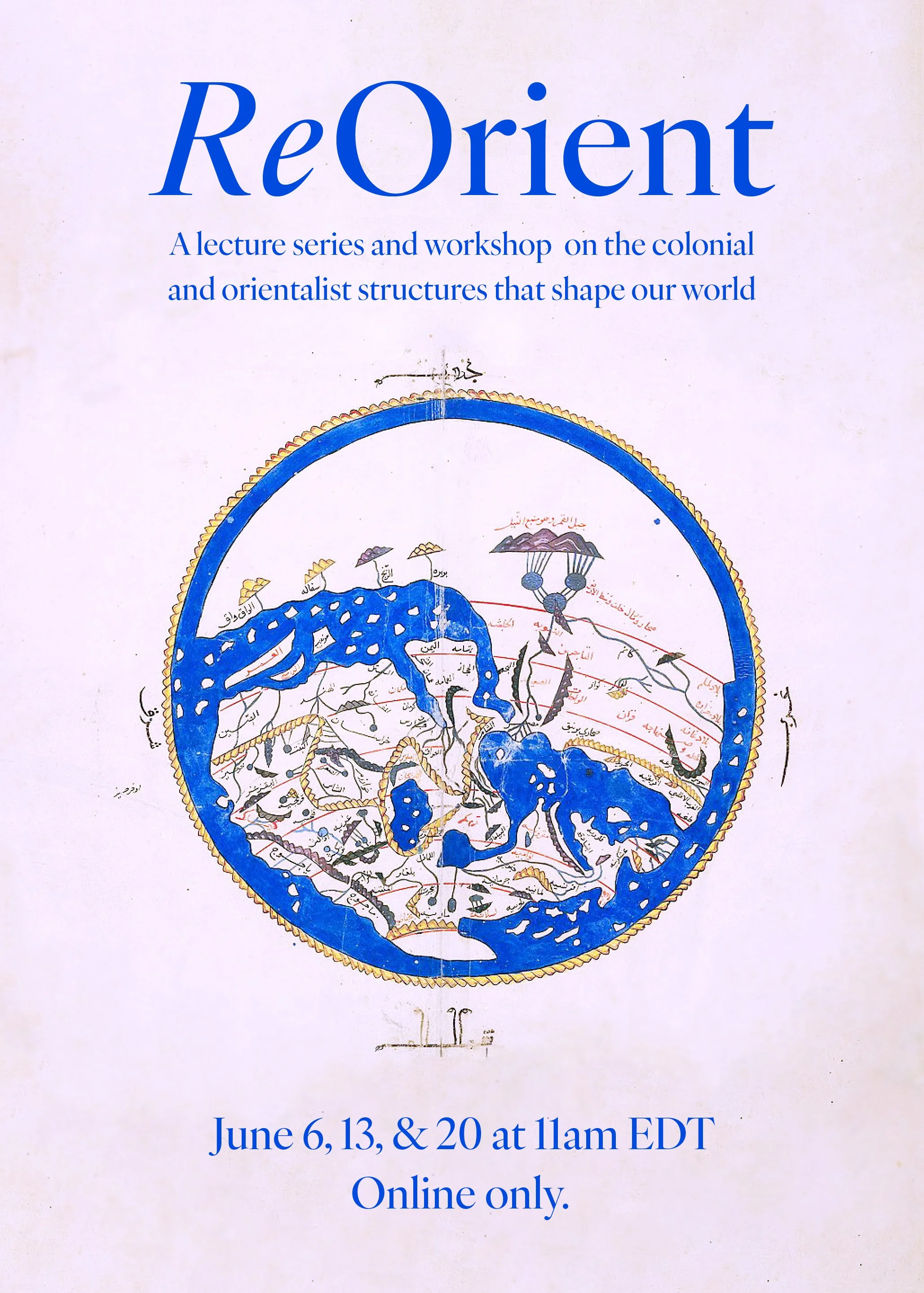
Above image: a world map made by Muhammad al-Idrisi in 1154 AD. A unique feature of this map is that it is south-up—a literal reorientation of how we perceive the world.
About the Series:
In this lecture series, we will explore the far-reaching consequences of colonialism and orientalism so that we can better understand our place in the world and the challenges we face today. Centuries of colonialism have impacted nearly every aspect of society in nearly every corner of the globe, and it continues to influence how we perceive current events, economics, social issues, and even ourselves. Indeed, the Orientalist narrative that arose out of colonial institutions still predominates in overt and subtle ways, silencing native voices and casting doubt on their perspectives, knowledge, and sense of identity. By examining the genealogy of such hegemonic paradigms, we can begin to confront and dispel the prevailing myths that enable and perpetuate inequalities across multiple domains.
The title of this lecture series, “ReOrient” is a play on words and an invitation to flip the narrative, shift paradigms, and strive towards making a world that is equitable, pluriversal, and multipolar.
When: CANCELLED. Future dates are TBD.
Audience: This lecture series is open to people of all backgrounds, and no prior knowledge is required to attend. However, as we will be discussing challenging topics, this series is not suitable for children.
Format: online only (platform TBD)
Presenter: Hajira Qazi. Collaborator: Shaan H. Khan (bios below)
Read more details by clicking on the headings below.
-
This is a three-part series comprising of two lectures and one workshop, with each session lasting between 1.5 to 2 hours. You may choose to attend any or all three of the sessions.
Session 1: “Intro to Decolonial Theory” on June 6: We will survey the core texts and theories that have spurred decolonization movements, both in the literal and metaphorical sense.
Session 2: “On Orientalism” on June 13: We will take a deeper look into Edward Said's theories on Orientalism and discuss the myriad ways it continues to influence how the Global South—particularly the Arab and Muslim world—sees itself in relation to the Global North.
Session 3: “Re-Worlding Workshop” on June 20: In this session we move from critique to creation— exploring how to decolonize our spaces, institutions, and ways of thinking. Together, we will question inherited norms, confront internalized paradigms, and begin to design small, meaningful interventions rooted in our own traditions and values. Moving beyond colonial and Orientalist frameworks, this session invites participants to create worlds on their own terms—worlds that are authentic, truthful, beneficial, just, and beautiful.
-
By the end of this series, attendees will be able to:
Think critically and reflectively on dominant paradigms that often go unquestioned
Begin to trace the genealogy of those dominant paradigms and the role that colonialism played in advancing them
Develop a sensitivity and respect for other ways of being, doing, and thinking
Achieve a familiarity with the major decolonial theorists and describe their foundational theories
Articulate the relevance of decolonial theory to contemporary social and political issues
Understand the theory of Orientalism and how it continues to influence institutions today
Identify the ways that coloniality impacts their own lives, and identify interventions that decolonize spaces in which they exist on the margins
-
Dr. Hajira Qazi is an educator and researcher with a PhD in design from Carnegie Mellon University (CMU) School of Design. She has taught both undergraduate and graduate level courses at CMU, including a 7-week course she developed entitled “Decoloniality: Past, Present, and Future.” You can read more about Dr. Qazi’s work here.
Shaan Hameed Khan is a graphic designer and education researcher working at the intersection of design, pedagogy, and the Islamic arts. Her practice is defined by an ongoing, deep-rooted study of the four core disciplines: Arabic calligraphy, sacred geometry, illumination, and manuscript illustration. By blending these classical traditions with contemporary graphic design, Shaan creates visual narratives and educational resources that honor heritage through modern storytelling. You can see her design work on her website here and follow her scholarly work here.